
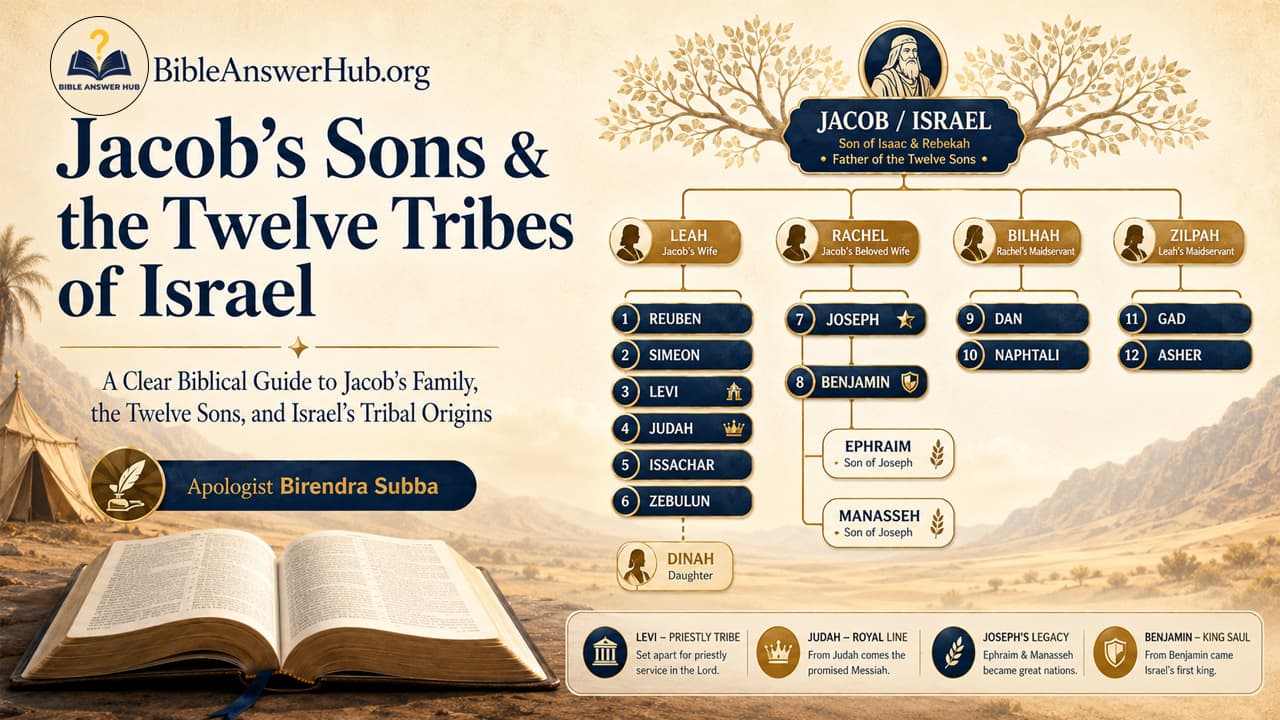
A chart-based guide to Jacob's twelve sons in Genesis — how the tribes of Israel were formed through Leah, Rachel, Bilhah, and Zilpah, and why Levi, Judah, Joseph, and Benjamin hold special roles in biblical history.
Introduction
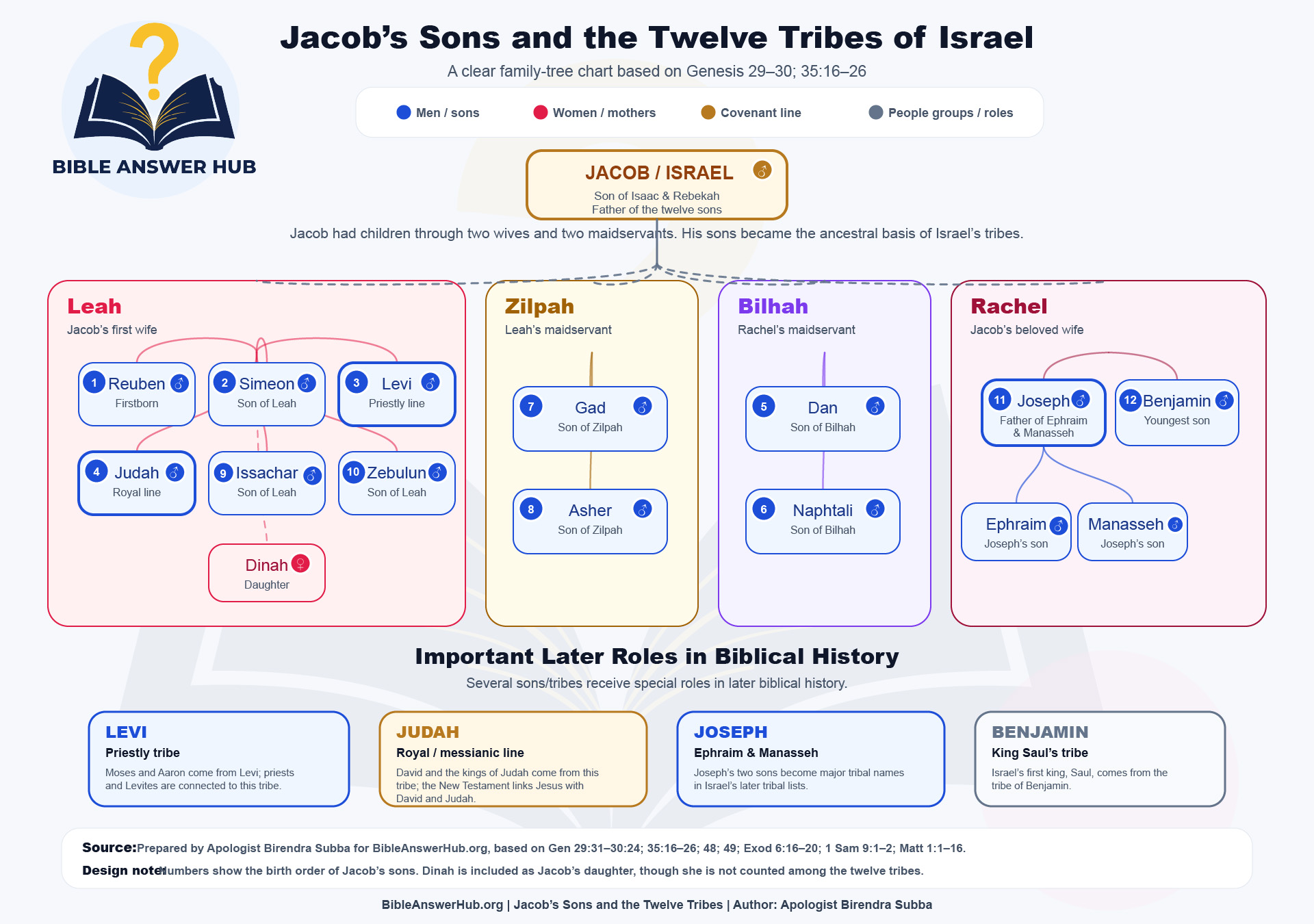
This chart explains the family of Jacob, whose name was later changed to Israel. Jacob is the son of Isaac and Rebekah, the grandson of Abraham and Sarah, and the father of the twelve sons who became the foundation of the twelve tribes of Israel. The chart helps readers understand how Jacob's family was formed through Leah, Rachel, Bilhah, and Zilpah, and how his sons later became central to the history of Israel.
Source: Genesis 29–30; 35:16–26; 46:8–27; 49:1–28
Jacob: The Central Figure of the Chart
The chart begins with Jacob, the younger twin son of Isaac and Rebekah. Jacob's brother was Esau. In Genesis 32:28, Jacob's name is changed to Israel after his encounter with God. This name becomes very important because the nation of Israel takes its name from Jacob.
Jacob becomes the father of twelve sons. These sons are later remembered as the ancestors of the twelve tribes of Israel. Therefore, the chart places Jacob / Israel at the center because all the tribal lines come from him.
Jacob's Four Family Lines
Jacob's children come through four women: Leah; Rachel; Bilhah; and Zilpah.
Leah and Rachel are sisters, daughters of Laban. Bilhah is Rachel's servant, and Zilpah is Leah's servant. Through these four women, Jacob has twelve sons and one daughter named Dinah.
The chart divides Jacob's children according to their mothers so that readers can clearly see which sons belong to which family line.
Leah's Line: Six Sons and Dinah
Leah is Jacob's first wife. Although Jacob loved Rachel more, Leah became the mother of many of Jacob's children. According to Genesis 29:31–35 and 30:17–21, Leah gave birth to six sons and one daughter.
Leah's sons are:
- Reuben
- Simeon
- Levi
- Judah
- Issachar
- Zebulun
Leah also gave birth to Dinah, Jacob's daughter.
Leah's line is very important because two of Israel's most significant tribes come from her: Levi and Judah.
Reuben: Jacob's Firstborn
Reuben is Jacob's firstborn son. As the firstborn, Reuben should have had a place of special honor. However, because of his sin involving Bilhah, his birthright status was damaged (Gen 35:22; 49:3–4).
In the later tribal history of Israel, Reuben becomes one of the tribes, but he does not become the leading tribe.
Simeon: Leah's Second Son
Simeon is Leah's second son. Simeon, together with Levi, is involved in the violent response to the incident involving their sister Dinah in Genesis 34. In Jacob's blessing in Genesis 49, Simeon and Levi are criticized for their anger and violence (Gen 49:5–7).
The tribe of Simeon later becomes one of the tribes of Israel, though it becomes less prominent in later biblical history.
Levi: The Priestly Line
Levi is Leah's third son. Although Jacob criticizes Levi in Genesis 49, the tribe of Levi later receives a special religious role in Israel. The Levites become connected with worship, priestly service, and temple ministry.
Moses and Aaron come from the tribe of Levi. Aaron's descendants become priests, while the broader tribe of Levi serves in religious duties connected to the tabernacle and later the temple.
Therefore, in the chart, Levi is marked as the priestly tribe.
Judah: The Royal and Messianic Line
Judah is Leah's fourth son. Judah becomes one of the most important sons of Jacob because the royal line comes through him. In Genesis 49:8–12, Jacob's blessing over Judah points to leadership, kingship, and authority.
Later, King David comes from the tribe of Judah. The kings of Judah also come from David's line. In Christian interpretation, Jesus Christ is also connected to the tribe of Judah and the line of David.
Therefore, in the chart, Judah is marked as the royal / messianic line.
Issachar and Zebulun
After the births of children through Bilhah and Zilpah, Leah later gives birth to two more sons: Issachar and Zebulun (Gen 30:17–20).
Issachar becomes one of the tribes of Israel. Zebulun also becomes one of the tribes and later receives territory in the land.
These sons show that Leah's family line is the largest among Jacob's wives, with six sons in total.
Dinah: Jacob's Daughter
Dinah is the daughter of Jacob and Leah (Gen 30:21). She is included in the chart because Genesis specifically names her. Although the twelve tribes come through Jacob's sons, Dinah is an important member of Jacob's family, especially because of the events recorded in Genesis 34.
In the chart, Dinah is shown separately as Jacob's daughter, not as one of the tribal fathers.
Rachel's Line: Joseph and Benjamin
Rachel is Jacob's beloved wife. For a long time, she is unable to have children. Eventually, God remembers Rachel, and she gives birth to Joseph (Gen 30:22–24). Later, she gives birth to Benjamin, but dies during childbirth (Gen 35:16–20).
Rachel's sons are:
- Joseph
- Benjamin
Rachel's line is very important because Joseph plays a major role in Genesis 37–50, and Benjamin later becomes the tribe from which Israel's first king, Saul, comes.
Joseph: Father of Ephraim and Manasseh
Joseph is the first son of Rachel and the eleventh son of Jacob. He becomes one of the most important figures in Genesis. Joseph is sold by his brothers, taken to Egypt, rises to power, and later becomes the means by which Jacob's family is preserved during famine.
Joseph's two sons are Ephraim and Manasseh (Gen 41:50–52; 48:1–20). Jacob later blesses Ephraim and Manasseh and gives them a special place among his descendants. Because of this, Ephraim and Manasseh often function as tribal representatives in place of Joseph.
This is why some biblical lists of the tribes include Ephraim and Manasseh instead of simply listing Joseph.
Benjamin: The Youngest Son
Benjamin is the youngest son of Jacob and the second son of Rachel. Rachel dies giving birth to him (Gen 35:16–20). Benjamin becomes the ancestor of the tribe of Benjamin.
The tribe of Benjamin becomes important later in Israel's history. King Saul, the first king of Israel, comes from the tribe of Benjamin.
Therefore, in the chart, Benjamin is identified with the later line of King Saul.
Bilhah's Line: Dan and Naphtali
Bilhah is Rachel's servant. Because Rachel is unable to have children at first, she gives Bilhah to Jacob. Through Bilhah, Jacob has two sons (Gen 30:1–8):
- Dan
- Naphtali
Rachel regards these sons as connected to her household because Bilhah is her servant. In the chart, Dan and Naphtali are placed under Bilhah, with a note that Bilhah is Rachel's servant.
Dan
Dan is the first son born through Bilhah. His name is connected with the idea of judgment, because Rachel says that God has judged in her favor (Gen 30:6).
Dan later becomes one of the tribes of Israel.
Naphtali
Naphtali is the second son born through Bilhah. His name is connected with Rachel's struggle with her sister Leah (Gen 30:8).
Naphtali also becomes one of the tribes of Israel.
Zilpah's Line: Gad and Asher
Zilpah is Leah's servant. After Rachel gives Bilhah to Jacob, Leah gives Zilpah to Jacob. Through Zilpah, Jacob has two sons (Gen 30:9–13):
- Gad
- Asher
In the chart, Gad and Asher are placed under Zilpah, with a note that Zilpah is Leah's servant.
Gad
Gad is the first son born through Zilpah. His name is associated with fortune or good luck in Genesis 30:11.
Gad later becomes one of the tribes of Israel.
Asher
Asher is the second son born through Zilpah. His name is connected with happiness or blessing (Gen 30:13).
Asher also becomes one of the tribes of Israel.
Birth Order in the Chart
The chart includes numbers beside the sons of Jacob to show their birth order. This helps readers understand the sequence in Genesis.
The order is:
- Reuben
- Simeon
- Levi
- Judah
- Dan
- Naphtali
- Gad
- Asher
- Issachar
- Zebulun
- Joseph
- Benjamin
This birth order comes mainly from Genesis 29:31–30:24 and Genesis 35:16–20.
Why There Are Sometimes More Than Twelve Names
Although Jacob has twelve sons, later biblical lists of the tribes are not always exactly the same. Sometimes Joseph is listed as one tribe. At other times, Joseph's two sons, Ephraim and Manasseh, are listed separately.
This can make the number look different in some passages. Another reason is that Levi is sometimes treated separately because Levi becomes the priestly tribe and does not receive land in the same way as the other tribes.
Therefore, readers should understand that the phrase "twelve tribes of Israel" is a covenantal and national expression, even though the exact tribal lists can vary in different biblical passages.
The Special Role of Levi
Levi's tribe becomes different from the others because of its priestly function. The Levites serve in connection with Israel's worship. The priests come from Aaron's line, and Aaron himself is from the tribe of Levi.
This is why the chart marks Levi as the priestly tribe.
The Special Role of Judah
Judah becomes the royal tribe. King David comes from Judah, and the kings of Judah come from David's line. In Christian theology, Jesus is identified as coming from the line of Judah and David.
This is why the chart marks Judah as the royal / messianic line.
The Special Role of Joseph
Joseph is important because his sons Ephraim and Manasseh receive special recognition. In later Israelite history, Ephraim becomes especially prominent among the northern tribes.
This is why the chart shows Joseph with Ephraim and Manasseh beneath him.
The Special Role of Benjamin
Benjamin is the youngest son of Jacob and becomes the ancestor of the tribe of Benjamin. King Saul, the first king of Israel, comes from Benjamin. Later, the apostle Paul also identifies himself as from the tribe of Benjamin.
This is why the chart notes Benjamin's later importance.
Why This Chart Matters
This chart is important because it helps readers understand the foundation of Israel's tribal identity. The nation of Israel does not appear suddenly in the Bible. It grows out of the family of Jacob, whose name becomes Israel.
The twelve sons of Jacob become the ancestral foundation for the twelve tribes. These tribes later appear throughout the Old Testament in the stories of the wilderness journey, the conquest of Canaan, the period of the judges, the monarchy, the divided kingdom, exile, and restoration.
Understanding Jacob's sons helps readers better understand much of the Old Testament. For Abraham's wider family background, see the companion article Abraham's Family Tree: Full Explanation.
Summary
Jacob, whose name was changed to Israel, became the father of twelve sons through Leah, Rachel, Bilhah, and Zilpah. Leah gave birth to Reuben, Simeon, Levi, Judah, Issachar, Zebulun, and Dinah. Rachel gave birth to Joseph and Benjamin. Bilhah gave birth to Dan and Naphtali. Zilpah gave birth to Gad and Asher. These twelve sons became the foundation of the twelve tribes of Israel. Among them, Levi became the priestly tribe, Judah became the royal and messianic line, Joseph's sons Ephraim and Manasseh became especially important tribal lines, and Benjamin became the tribe of King Saul. Therefore, this chart shows how the family of Jacob became the tribal foundation of biblical Israel.