
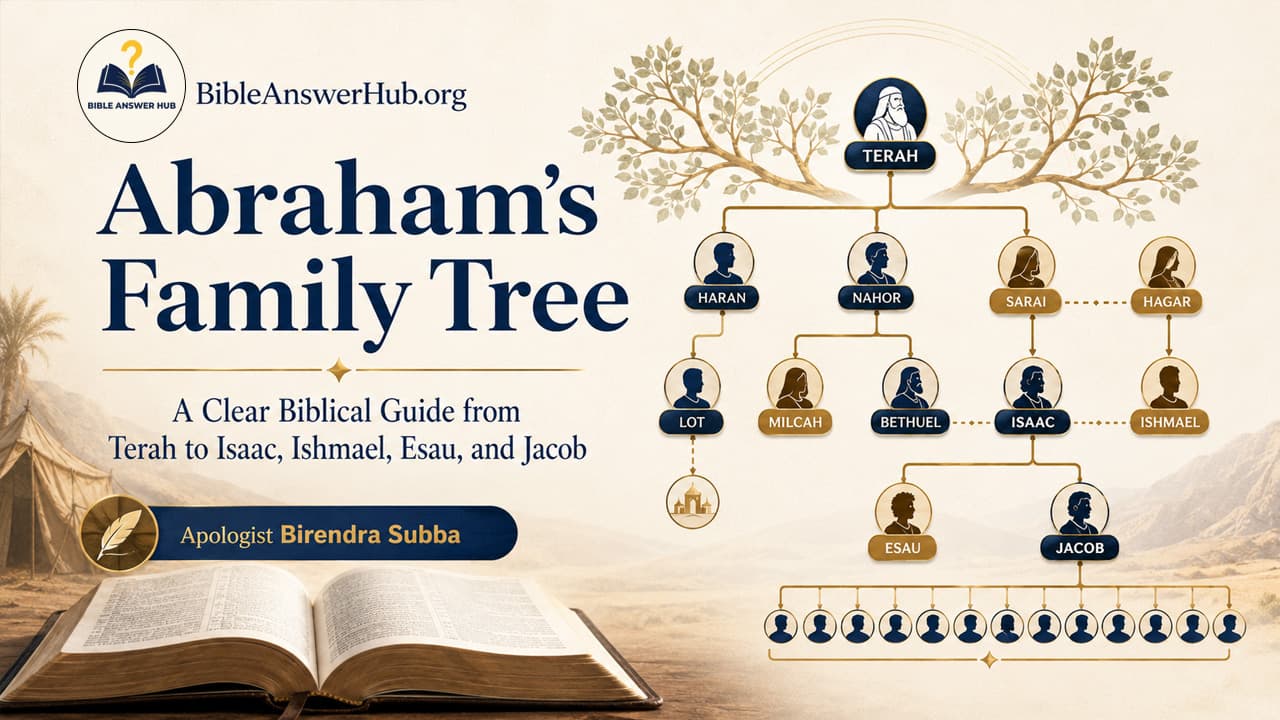
A visual guide to Abraham's family line in Genesis — from Terah to Isaac, Ishmael, Jacob, Esau, and the peoples connected to Abraham's wider household, including the covenant line that leads to Israel.
Introduction
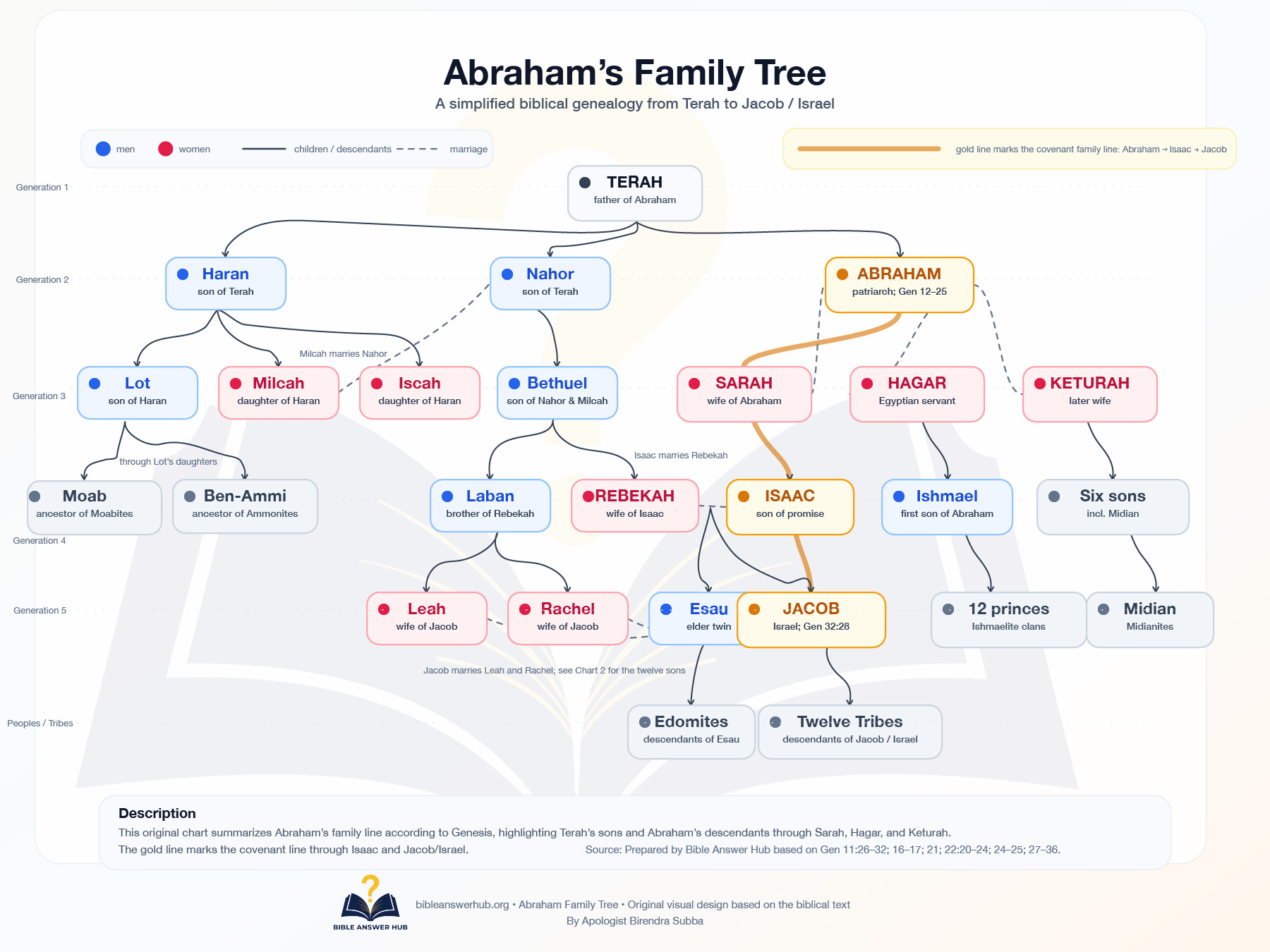
This chart explains the family line of Abraham according to the book of Genesis. It begins with Terah, the father of Abraham, and traces the major family branches that later become important in the biblical story. The purpose of the chart is to help readers understand how Abraham is connected to Isaac, Ishmael, Jacob, Esau, the Israelites, the Edomites, the Moabites, the Ammonites, and other related peoples in Genesis.
Terah: The Starting Point of the Chart
The chart begins with Terah. According to Genesis 11:26–32, Terah is the father of three important sons: Abram, later called Abraham; Nahor; and Haran.
Terah's family originally came from Ur of the Chaldeans and later settled in Haran. This is important because Abraham's story does not begin in Canaan. His family background is connected to Mesopotamia. From Terah's three sons, three major family lines appear in the chart: Haran's line, Nahor's line, and Abraham's line.
Haran's Line: Lot, Moabites, and Ammonites
The first branch under Terah is Haran. Haran is the father of Lot. Lot is Abraham's nephew. After Haran dies, Lot travels with Abraham for part of Abraham's journey (Gen 11:27–31; 12:4–5).
Later, Lot becomes important because his descendants become two neighboring peoples of Israel: the Moabites and the Ammonites. According to Genesis 19:30–38, Lot's two daughters give birth to sons named Moab and Ben-Ammi. Moab becomes the ancestor of the Moabites, and Ben-Ammi becomes the ancestor of the Ammonites.
This part of the chart shows that Abraham's wider family is connected not only to Israel but also to other nations that later appear in Old Testament history.
Nahor's Line: Rebekah, Laban, Leah, and Rachel
The second branch under Terah is Nahor. Nahor marries Milcah, who is the daughter of Haran (Gen 11:29). Their family line is very important because it later connects back to Abraham's descendants through marriage.
Nahor and Milcah's line leads to Bethuel (Gen 22:20–24). Bethuel becomes the father of Rebekah and Laban. Rebekah becomes the wife of Isaac, Abraham's son (Gen 24:15–67). Laban becomes the father of Leah and Rachel, who later become wives of Jacob (Gen 29:15–30).
This means that Isaac and Jacob both marry women from Abraham's extended family. Rebekah, Leah, and Rachel are not strangers to Abraham's household; they come from the wider family line of Nahor. This helps explain why Abraham sends his servant back to his relatives to find a wife for Isaac in Genesis 24.
Abraham: The Main Figure of the Chart
The central figure of the chart is Abram, whose name is later changed by God to Abraham (Gen 17:5). Abraham is the main character of Genesis 12–25. God calls him to leave his homeland and promises to make him into a great nation, bless him, give land to his descendants, and make him a blessing to all families of the earth (Gen 12:1–3; 15:1–21; 17:1–8).
Abraham's family line is shown through three women: Sarah; Hagar; and Keturah. Each of these women is connected to a different branch of Abraham's descendants.
Sarah's Line: Isaac, the Covenant Line
Sarah is Abraham's wife. At first, she is barren and has no child (Gen 11:30). This creates a major problem in the story because God has promised Abraham descendants, but Abraham and Sarah have no son for many years.
In Genesis 17:15–21 and Genesis 21:1–7, God promises that Sarah herself will have a son. This son is Isaac. Isaac is born when Abraham and Sarah are very old. His birth is therefore presented as the result of God's promise and power.
In the chart, the line from Abraham → Sarah → Isaac should be understood as the main covenant line. This does not mean God ignores Abraham's other descendants, but Genesis clearly presents Isaac as the son through whom the covenant promise continues (Gen 17:19–21; 21:12).
Hagar's Line: Ishmael and the Twelve Princes
Hagar is Sarah's Egyptian servant. Because Sarah is unable to have children, she gives Hagar to Abraham, and Hagar gives birth to Ishmael (Gen 16:1–16).
Ishmael is Abraham's firstborn son. Although he is not the covenant heir in the same way Isaac is, God still hears Hagar's suffering and promises that Ishmael will become a great people (Gen 16:10–12; 17:20; 21:13, 18).
Genesis 25:12–16 lists Ishmael's twelve sons and describes them as twelve princes. Therefore, in the chart, Ishmael's line is shown as leading to the twelve princes of Ishmael or the Ishmaelite tribes. This reminds readers that Ishmael is also part of Abraham's family and receives divine blessing, even though the covenant line continues through Isaac.
Keturah's Line: Abraham's Later Descendants
After Sarah's death, Abraham takes another wife named Keturah (Gen 25:1–4). Through Keturah, Abraham has six sons: Zimran, Jokshan, Medan, Midian, Ishbak, and Shuah.
Among them, Midian becomes especially important because the Midianites later appear in the biblical narrative. Moses, for example, flees to Midian and marries Zipporah, the daughter of Jethro, a priest of Midian (Exod 2:15–22).
This part of the chart shows that Abraham's descendants extend beyond Isaac and Ishmael. Abraham becomes the ancestor of several peoples, which fits the promise that he would become "the father of many nations" (Gen 17:4–6).
Isaac and Rebekah: The Next Generation
Isaac, the son of Abraham and Sarah, marries Rebekah, who comes from Nahor's family line (Gen 24:15–67). Their marriage connects Abraham's covenant line with his extended family in Mesopotamia.
Isaac and Rebekah have twin sons: Esau; and Jacob. Their story is important because the next stage of the biblical family line continues through Jacob, not Esau (Gen 25:19–26; 27:1–29).
Esau: Ancestor of the Edomites
Esau is the older twin son of Isaac and Rebekah. He is also called Edom (Gen 25:30; 36:1). Esau becomes the ancestor of the Edomites (Gen 36:1–43).
The Edomites later became a neighboring people of Israel. The relationship between Jacob and Esau, therefore, becomes more than a family story; it also serves as a backdrop for the later relationship between Israel and Edom. In the chart, Esau's line is shown moving toward the Edomites.
Jacob: Israel and the Twelve Tribes
Jacob is the younger twin son of Isaac and Rebekah. His name is later changed to Israel (Gen 32:28). This name is extremely important because Jacob becomes the father of the twelve sons who form the foundation of the twelve tribes of Israel.
Jacob marries Leah and Rachel, the daughters of Laban, and also has children through Bilhah and Zilpah (Gen 29:31–30:24; 35:16–26). These sons become the tribal ancestors of Israel.
In the chart, Jacob is shown as the continuation of the covenant line from Abraham and Isaac. The detailed sons of Jacob are not fully expanded in this first chart because they belong to a future companion chart: "Jacob's Sons and the Twelve Tribes of Israel."
The Covenant Line in the Chart
The most important line in the chart is:
Abraham → Isaac → Jacob/Israel → Twelve Tribes of Israel
This line shows the main movement of the promise in Genesis. God calls Abraham, gives him promises, confirms the covenant through Isaac, and continues the family line through Jacob, whose descendants become Israel.
This covenant line does not mean the other branches are meaningless. Hagar's son Ishmael is blessed. Keturah's sons become peoples. Esau becomes the ancestor of Edom. Lot's line becomes Moab and Ammon. But the main biblical story of Israel moves through Isaac and Jacob.
Why This Chart Matters
This chart helps readers understand the larger family context of the Old Testament. Many later nations and people groups are connected to Abraham's wider family. The chart shows that Genesis is not only telling the story of one individual but also explaining the origins of several peoples who later appear throughout the Bible.
It also helps readers distinguish between Abraham's wider descendants and the specific covenant line. Abraham is the father of many nations, but the biblical covenant line in Genesis continues through Sarah's son Isaac and then through Jacob, whose name becomes Israel.
Summary
Abraham's family tree begins with Terah and branches into several important biblical lines. Haran's line leads to Lot, Moab, and Ammon. Nahor's line leads to Rebekah, Laban, Leah, and Rachel. Abraham's own line develops through Sarah, Hagar, and Keturah. Through Sarah comes Isaac, the child of promise. Through Hagar comes Ishmael, the father of twelve princes. Through Keturah came six more sons, including Midian. Isaac and Rebekah have Esau and Jacob. Esau becomes the ancestor of Edom, while Jacob becomes Israel, the father of the twelve tribes. Therefore, the chart shows both the wide family network of Abraham and the central covenant line that leads to Israel.